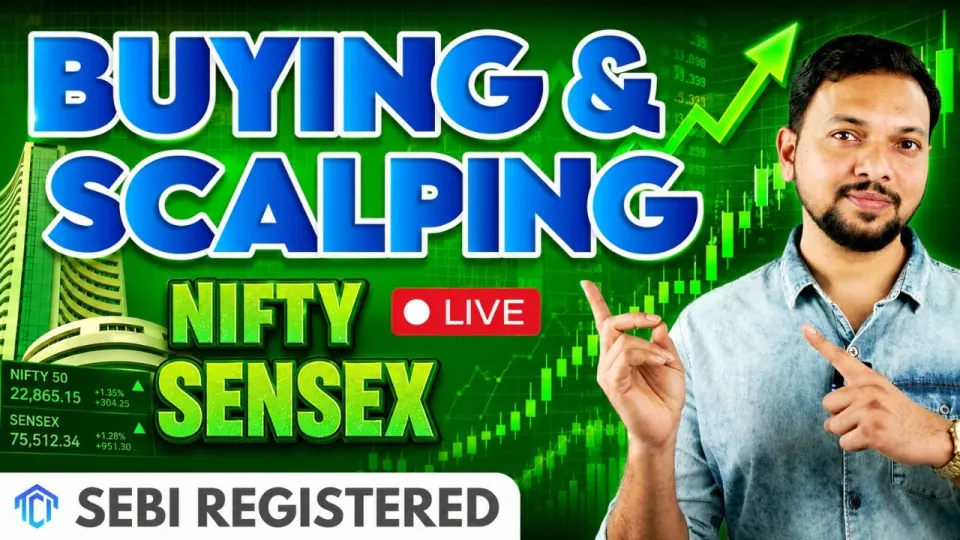
What does live trading Nifty, BankNifty and SENSEX with option buying actually require from a trader?
Need articles like this for your video? They help promote it on YouTube and Google — order them in the Telegram bot @sat_sit_bot. The bot writes and publishes the articles itself (with your YouTube video embedded) on popular topical websites (no ads). Free trial — 50 articles.
· based on the channel TRADING CAFE INDIA
Trading in the Indian index derivatives market means taking a view on Nifty 50, BankNifty or SENSEX and expressing it through options, usually by buying a call or a put rather than trading futures. A live option-buying session shows that process in real time: reading the index, picking a strike, sizing the position and managing the premium. Access to the broker-side research and call service used in the broadcast is available through the Lemonn registration link.
What live trading on Nifty, BankNifty and SENSEX actually involves
Live trading in this format is intraday option buying on three Indian benchmarks, with the index chart as the primary signal and the option premium as the risk unit. The trader watches the underlying, not the option price alone, because the option only reflects what the index does.
- Pick one index per session. Nifty 50 is the broadest and most liquid, BankNifty is the most volatile of the three, and SENSEX offers a different strike grid and expiry calendar.
- Define a directional bias from the index chart — a breakout, a range, or a trend continuation — before looking at any strike.
- Choose a strike close enough to the money to have delta, but cheap enough that the premium is an acceptable loss.
- Set the stop on the index level, not on the option price, then convert that into a rupee loss on the premium.
- Exit on the target, on the stop, or on time — intraday option buyers who hold into the close pay theta for nothing.
How the three indices differ for an option buyer
SENSEX options are cash-settled and quoted on the BSE index, while Nifty and BankNifty options are tied to the NSE benchmarks, and that difference shapes strike selection and expiry choice. SENSEX trades in a strike interval of 100 points, which makes the ladder around a level like 74,000 or 74,300 easy to read: the distance between strikes is small relative to the index, so a 1,000-point index move crosses about ten strikes. BankNifty moves faster in percentage terms, so the same premium buys less time and less comfort. Nifty sits between the two and carries the deepest liquidity, which usually means tighter spreads and easier fills.
Expiry matters as much as direction. Weekly contracts decay fastest in their final sessions, so a buyer who is right on direction but late on timing can still lose the entire premium. Monthly contracts give more room but cost more upfront.
Position sizing and the real cost of buying premium
The maximum loss on a long option is the premium paid, and that single fact is what makes option buying attractive — and what makes traders underprice everything else. A premium of a few thousand rupees per lot looks small until it is repeated across several failed attempts in one session.
A practical framework:
- Cap the loss per trade at a fixed percentage of capital, for example 1–2%, and divide that by the premium per lot to get the lot count.
- Treat the premium as spent money the moment the order fills; the question is only whether it returns with profit.
- Add brokerage, exchange charges, STT on the sell side and the bid-ask spread to the cost of every round trip.
- Avoid averaging down on a losing option position; adding premium to a thesis that is already wrong increases the loss, not the probability.
Reading the session: levels, momentum and the temptation to chase
A live session is mostly a test of patience, because the index spends more time ranging than trending. Traders who buy options on every candle spend their premium on noise. The more disciplined approach is to mark a few reference levels before the open — previous day high and low, the opening range, and any obvious round number — and only act when price reaches one of them with momentum behind it.
On a day when an index pushes to a fresh high, the option buyer's problem is rarely direction; it is entry price. Buying the breakout candle at its peak means paying the highest premium of the move, and a normal pullback then wipes out most of the value. Waiting for a retest, or buying a slightly further strike, usually produces a better risk-to-reward even if the win rate falls.
Common questions traders raise during live sessions
Three themes come up repeatedly from viewers of this kind of broadcast: whether a position can be held overnight, how far an index can realistically travel, and why a trade that looked correct still lost money.
- Holding a call overnight. Carrying an option position into the next session exposes the buyer to gap risk and to a full night of time decay, so it only makes sense when the thesis is based on a multi-day move and the premium is small relative to capital.
- Index targets. A round target such as 74,300 on SENSEX or a specific Nifty level is a scenario, not a promise; the option's payout depends on how quickly and how far the index gets there before expiry.
- Losing despite a correct read. A trader can be right on direction and still lose if the move is slow, if the strike is too far out of the money, or if the entry premium was inflated by an earlier spike in implied volatility.
- Where to follow the calls. The channel routes viewers to a free Telegram group and to a paid premium channel, and the difference in latency between the two is itself a risk factor for anyone copying entries.
Risk, regulation and what the disclaimer means in practice
Trading Café India is registered with SEBI as a Research Analyst under registration number INH000013767, and the broadcast carries the standard warning that securities market investments are subject to market risk. Registration as a research analyst is not a performance guarantee, and it does not convert a live demonstration into personalised advice.
Two practical consequences follow. First, every trade shown is illustrative; the position size, capital and risk tolerance of the person on screen are unknown to the viewer. Second, the channel explicitly notes that forex-related content and non-Indian brokers such as XM are intended for viewers outside India, since trading currency pairs without INR or using brokers not registered in India conflicts with the FEMA framework. Indian residents should verify any broker against the RBI list before depositing funds.
Useful links
- Lemonn — SEBI-registered calls registration
- Nifty and Sensex VIP setups
- Free Telegram channel
- XM broker signup
- CoinSwitch Pro for crypto
The bottom line on live index option buying
Live option buying on Nifty, BankNifty and SENSEX rewards preparation more than reaction: a defined index level, a strike chosen for delta rather than hope, and a premium small enough that being wrong twice in a row is survivable. The three indices behave differently — SENSEX with its 100-point strike grid, BankNifty with its speed, Nifty with its liquidity — and the same strategy rarely transfers between them without adjustment. The session reviewed here was produced by TRADING CAFE INDIA, which publishes daily live trading broadcasts and routes viewers to its research service through the Lemonn affiliate registration page. Treat every demonstration as education, size positions as if the next trade will lose, and confirm any broker or advisory against official registers before committing capital.
Key takeaways
- Live sessions on TRADING CAFE INDIA cover three Indian indices: Nifty 50, BankNifty and SENSEX, all traded through options rather than futures.
- Option buying caps the maximum loss at the premium paid, but the premium itself can decay to zero if the index does not move fast enough.
- Sensex weekly and monthly contracts are cash-settled against the index; strike spacing is 100 points, so a 73,000–74,300 move covers roughly 13 strikes.
- Trading Café India is registered with SEBI as a Research Analyst under registration number INH000013767.
- Broker-side costs, bid-ask spreads and slippage matter more in option buying than in equity delivery because positions are short-lived.
Source: LIVE TRADING Nifty BankNifty and SENSEX | Option Buying | 15 Oct #livetrading · Markdown version
Questions & answers
Can I hold an option buying position overnight after a live session ends?
You can, but the trade becomes a different one. Overnight you carry time decay and gap risk, and a gap against you can erase the premium before you get a chance to exit. Holding makes sense only when the thesis targets a multi-day move and the premium is a small fraction of your capital.
How far can SENSEX or Nifty realistically move in one session?
Most sessions produce a range well under 1% of the index level, with occasional trend days that extend further. A specific target such as 74,300 on SENSEX is a scenario to plan around, not a forecast. Because SENSEX strikes are spaced 100 points apart, even a moderate move crosses several strikes, which is why entry premium matters so much.
Why do I lose money on option buying even when the index goes my way?
Three usual causes: the move is too slow, so time decay eats the premium; the strike is too far out of the money, so delta stays low; or the entry was made at an inflated premium during a volatility spike. Buying closer to the money and entering on a pullback rather than a spike usually reduces this problem.
Is a SEBI research analyst registration a guarantee of returns?
No. Trading Café India holds SEBI Research Analyst registration INH000013767, but registration only confirms the entity meets regulatory requirements for issuing research. It says nothing about profitability, and it does not turn broadcast content into personal advice for your capital and risk profile.